The Whole Learner in ABA: Ethics, Neuropsychology, and Psychoeducational Assessment for Better Programming
About Course
This 2-part professional training series is designed for behavior analysts who want to strengthen their ability to use clinical, neuropsychological, and psychoeducational information ethically and effectively in ABA practice. Together, the webinars help BCBAs, BCaBAs, clinical supervisors, school-based behavior analysts, and interdisciplinary team members move beyond isolated behavior plans and develop more informed, person-centered programming based on the whole learner.
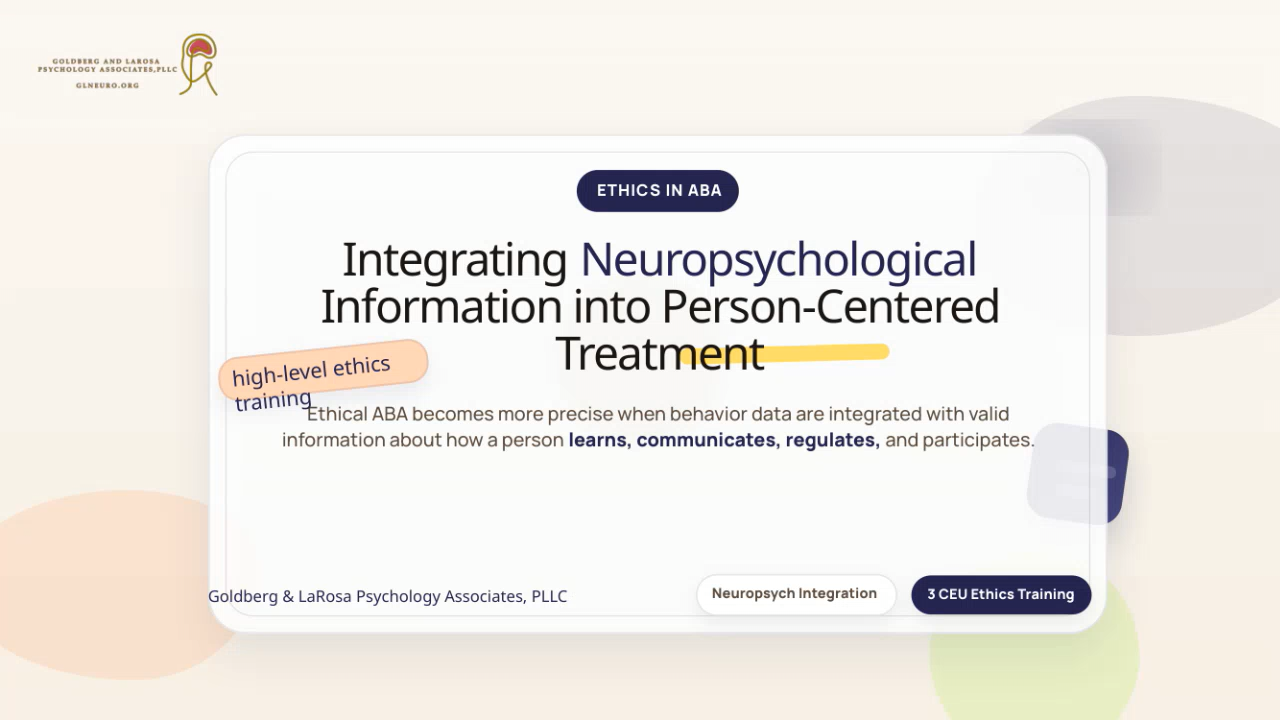
The first webinar focuses on the ethical integration of neuropsychological, psychological, psychiatric, medical, developmental, and psychoeducational information into ABA treatment planning. Participants will learn how the BACB Ethics Code supports collaboration, scope of competence, referral, consultation, individualized treatment, and responsible use of assessment findings.
The training emphasizes how behavior analysts can ethically use information from neuropsychological reports without stepping outside their professional role, while still appreciating how executive functioning, attention, memory, language, sensory processing, emotional regulation, neurological history, and diagnostic complexity may affect behavior and learning.
The second webinar provides a practical introduction to understanding common psychoeducational scores and how they may inform ABA programming. Measures such as the WISC and Woodcock-Johnson are reviewed in terms of what their scores can mean for instructional planning, task analysis, prompting, reinforcement, goal selection, accommodations, generalization, and progress monitoring.
Participants will learn how to understand score types commonly found in reports, including standard scores, percentile ranks, confidence intervals, index scores, cluster scores, age equivalents, and grade equivalents, while recognizing the ethical limits of interpretation.
Across both trainings, the central goal is to help behavior analysts use existing evaluation data more thoughtfully, collaboratively, and ethically. These webinars do not train BCBAs to diagnose, administer psychological tests, or replace neuropsychologists or psychologists. Instead, they teach ABA professionals how to understand the treatment relevance of assessment findings, ask better interdisciplinary questions, collaborate more effectively with evaluators and school teams, and design goals that reflect the learner’s cognitive, academic, adaptive, emotional, and neurodevelopmental profile.
This series is especially relevant for practitioners working with autistic learners, students with learning disabilities, ADHD, intellectual disability, executive-function weaknesses, language delays, emotional or behavioral concerns, complex developmental profiles, or school-based support needs.
Format: 2-part on-demand webinar series
Length: 2 hours, 45 minutes
CEUs: 3 BACB Ethics CEUs
Ethics Category: This webinar is designed to satisfy 3 BACB ethics CEUs toward the ethics continuing education requirement for BCBA and BCaBA recertification.
Presenter: Dr. Vanetta LaRosa
Audience: BCBAs, BCBA-Ds, BCaBAs, clinical supervisors, ABA program directors, school-based behavior analysts, interdisciplinary team members, educators, and professionals supporting learners with autism, ADHD, learning disabilities, intellectual disability, executive-function weaknesses, language delays, emotional or behavioral concerns, or complex developmental profiles
Learning Objectives
- Describe how clinical, neuropsychological, psychoeducational, medical, developmental, and diagnostic information can inform ethical ABA treatment planning.
- Identify BACB Ethics Code considerations related to scope of competence, collaboration, referral, consultation, individualized treatment, and responsible use of assessment findings.
- Explain how executive functioning, attention, memory, language, sensory processing, emotional regulation, neurological history, and diagnostic complexity may affect behavior, learning, and treatment response.
- Recognize the ethical limits of using neuropsychological and psychoeducational reports in ABA practice, including the distinction between using assessment findings and diagnosing or administering psychological tests.
- Interpret common psychoeducational score types at a practical level, including standard scores, percentile ranks, confidence intervals, index scores, cluster scores, age equivalents, and grade equivalents.
- Describe how findings from measures such as the WISC and Woodcock-Johnson may inform instructional planning, task analysis, prompting, reinforcement, accommodations, goal selection, generalization, and progress monitoring.
- Use assessment information to ask better interdisciplinary questions and collaborate more effectively with psychologists, neuropsychologists, school teams, educators, medical providers, and caregivers.
- Design ABA programming that reflects the learner’s cognitive, academic, adaptive, emotional, behavioral, and neurodevelopmental profile.
Disclaimer
This training is for professional education only. Assessment instruments are discussed only at the level of general clinical purpose and treatment-planning implications. No proprietary test items, scoring forms, protocols, stimulus materials, rating-scale items, or administration procedures are reproduced. Participants should consult official publishers, manuals, and professional standards for authorized test administration, scoring, and interpretation.
The Whole Learner in ABA: Ethics, Neuropsychology, and Psychoeducational Assessment for Better Programming
-
Part 1: Ethical Integration of Neuropsychological and Clinical Information in ABA Practice
02:09:09 -
Part 2: Understanding Psychoeducational Scores for ABA Programming
35:11 -
Quiz
Contact
We’re here to help you understand the next step
Reach out if you would like to discuss a referral question, the type of evaluation you may need, scheduling, or whether our practice is the right fit.