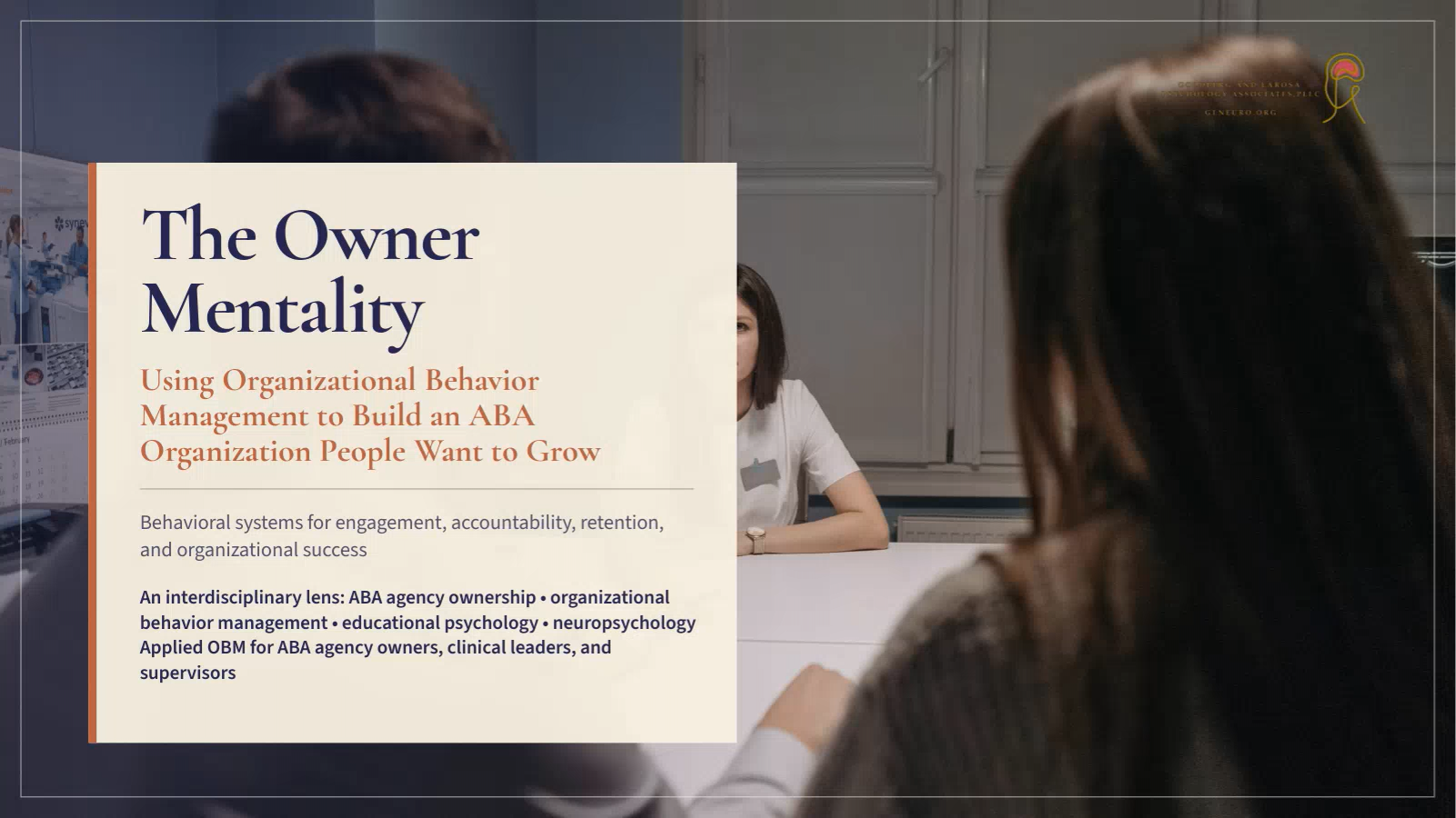
The Owner Mentality: Using OBM to Build an ABA Organization People Want to Grow
About Course
What makes an ABA organization successful, and what makes talented employees want to stay, contribute, and grow with it?
In this practical CEU webinar, Vanetta R. LaRosa, Ph.D., BCBA-D, LBA, Licensed Psychologist, draws on 20 years of experience as an ABA business owner, along with her background in behavior analysis, educational psychology, and neuropsychology.
Using principles of Organizational Behavior Management (OBM), Dr. LaRosa examines what it takes to build and grow an ABA organization in the real world. Participants will learn practical strategies for improving employee performance, increasing initiative and accountability, strengthening retention, developing future leaders, reducing unnecessary response effort, and creating systems that allow an organization to grow without requiring the owner to personally solve every problem.
The webinar introduces Dr. LaRosa’s Owner Mentality framework, a behavioral approach to helping employees understand how their performance contributes to organizational success while providing appropriate responsibility, autonomy, feedback, and opportunities for professional growth.
Real-world ABA business examples and lessons from two decades of ownership are integrated throughout the training, connecting the science of OBM to everyday challenges involving hiring, supervision, staff performance, retention, workflow, leadership development, and organizational growth.
This webinar is especially relevant for BCBAs who supervise or lead teams, as well as behavior analysts who are considering opening, growing, or managing an ABA practice.
Format: On-demand webinar
Length: 50 minutes
CEUs: 1 BACB Learning CEU
Presenter: Vanetta R. LaRosa, Ph.D., BCBA-D, LBA, Licensed Psychologist
Audience: BCBAs, BCBA-Ds, BCaBAs, ABA agency owners, clinical directors, supervisors, managers, and aspiring ABA business owners
Includes: CEU post-test and certificate of completion
Learning Objectives
- Identify at least three organizational variables that may contribute to employee performance problems in ABA service organizations.
- Differentiate employee skill deficits from performance problems related to task clarification, workflow, response effort, resources, feedback, and consequences.
- Describe how OBM principles can be used to increase employee initiative, accountability, problem solving, and meaningful contribution within an ABA organization.
- Identify organizational practices that may influence employee retention, including supervision, feedback, workload, reinforcement, role clarity, and opportunities for professional growth.
- Describe strategies for developing leadership systems that progressively increase appropriate employee responsibility and autonomy while reducing excessive dependence on the business owner.
- Apply the Owner Mentality framework to identify at least one measurable employee behavior and one organizational system change that could improve performance within an ABA organization.
Disclaimer
This training is for professional education only. Assessment instruments are discussed only at the level of general clinical purpose and treatment-planning implications. No proprietary test items, scoring forms, protocols, stimulus materials, rating-scale items, or administration procedures are reproduced. Participants should consult official publishers, manuals, and professional standards for authorized test administration, scoring, and interpretation.
Video
-
Video
49:33 -
Quiz
Student Ratings & Reviews

Contact
We’re here to help you understand the next step
Reach out if you would like to discuss a referral question, the type of evaluation you may need, scheduling, or whether our practice is the right fit.