PDDBI Case Vignettes, Scoring, and Interpretation for BCBAs
About Course
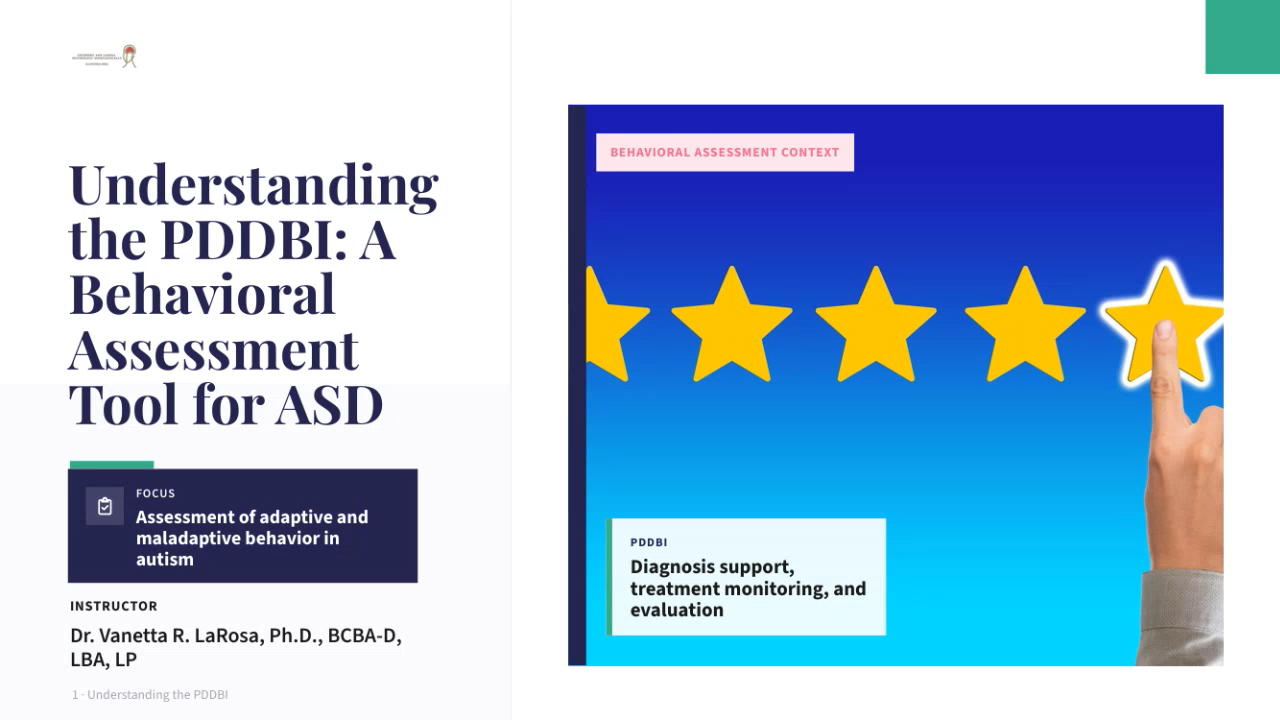
This 2-part on-demand webinar introduces behavior analysts to the practical use of the Pervasive Developmental Disorder Behavior Inventory, or PDDBI, as a tool for understanding autism-related behavioral, social, communication, adaptive, and maladaptive patterns.
Participants will learn how the PDDBI is structured, scored, interpreted, and applied in BCBA practice. The course reviews parent and teacher forms, adaptive and maladaptive domains, T-score interpretation, composite scores, validity considerations, and the importance of comparing behavior patterns across home and school settings.
Part 1 focuses on the PDDBI framework, including how the measure captures both strengths and challenges across domains such as social pragmatics, expressive and receptive language, learning and memory, social approach, rituals, resistance to change, sensory responding, arousal regulation, fear, and aggression. Participants will learn how PDDBI profiles can support treatment planning, progress monitoring, caregiver collaboration, and interdisciplinary decision-making.
Part 2 focuses on case applications and clinical interpretation. Through case vignettes, participants will practice moving from item ratings to raw scores, T-scores, severity statements, functional hypotheses, and ABA treatment recommendations. The session emphasizes interpreting PDDBI patterns as structured hypotheses that should be confirmed through direct observation, caregiver and teacher reports, ABC data, and functional behavior assessment.
The webinar highlights how elevated scores in areas such as rituals, sensory responding, arousal, fear, anxiety-related rigidity, or social communication difficulties can guide further assessment and individualized intervention planning. Participants will review examples involving autism, language delay, sensory dysregulation, anxiety-related avoidance, rigid routines, and cross-setting differences between home and school.
Format: 2-part on-demand webinar
Length: 50 minutes
CEUs: 1 BACB CEU
Presenter: Dr. Vanetta LaRosa
Audience: BCBAs, BCaBAs, behavior analysts, clinical supervisors, autism service providers, school-based behavior consultants, and professionals working with children with autism spectrum disorder, developmental delays, complex behavior profiles, or interdisciplinary evaluation teams
Learning Objectives
- Describe the basic structure of the PDDBI, including parent and teacher forms, adaptive domains, maladaptive domains, and composite scores.
- Interpret PDDBI T-scores accurately, including the different meanings of high scores in adaptive versus maladaptive domains.
- Identify clinically meaningful PDDBI patterns related to language, social pragmatics, rituals, sensory responding, arousal regulation, fear, aggression, and social approach.
- Compare parent and teacher ratings to identify cross-setting differences and plan for generalization, environmental adjustments, and caregiver collaboration.
- Use PDDBI findings to generate functional hypotheses that can be tested through direct observation, ABC data, and functional behavior assessment.
- Translate PDDBI score profiles into ethical ABA recommendations, including functional communication training, tolerance training, exposure hierarchies, sensory supports, transition supports, reinforcement strategies, and progress monitoring plans.
- Recognize ethical boundaries when using PDDBI data, including the need to avoid standalone diagnosis and to collaborate with psychologists or other qualified professionals when diagnostic interpretation is involved.
Disclaimer
This training is for professional education only. Assessment instruments are discussed only at the level of general clinical purpose and treatment-planning implications. No proprietary test items, scoring forms, protocols, stimulus materials, rating-scale items, or administration procedures are reproduced. Participants should consult official publishers, manuals, and professional standards for authorized test administration, scoring, and interpretation.
PDDBI Case Vignettes, Scoring, and Interpretation for BCBAs
-
Part 1
30:28 -
Part 2
18:11 -
Quiz
Student Ratings & Reviews

Contact
We’re here to help you understand the next step
Reach out if you would like to discuss a referral question, the type of evaluation you may need, scheduling, or whether our practice is the right fit.