
Neuropsychology-Informed Shaping
About Course
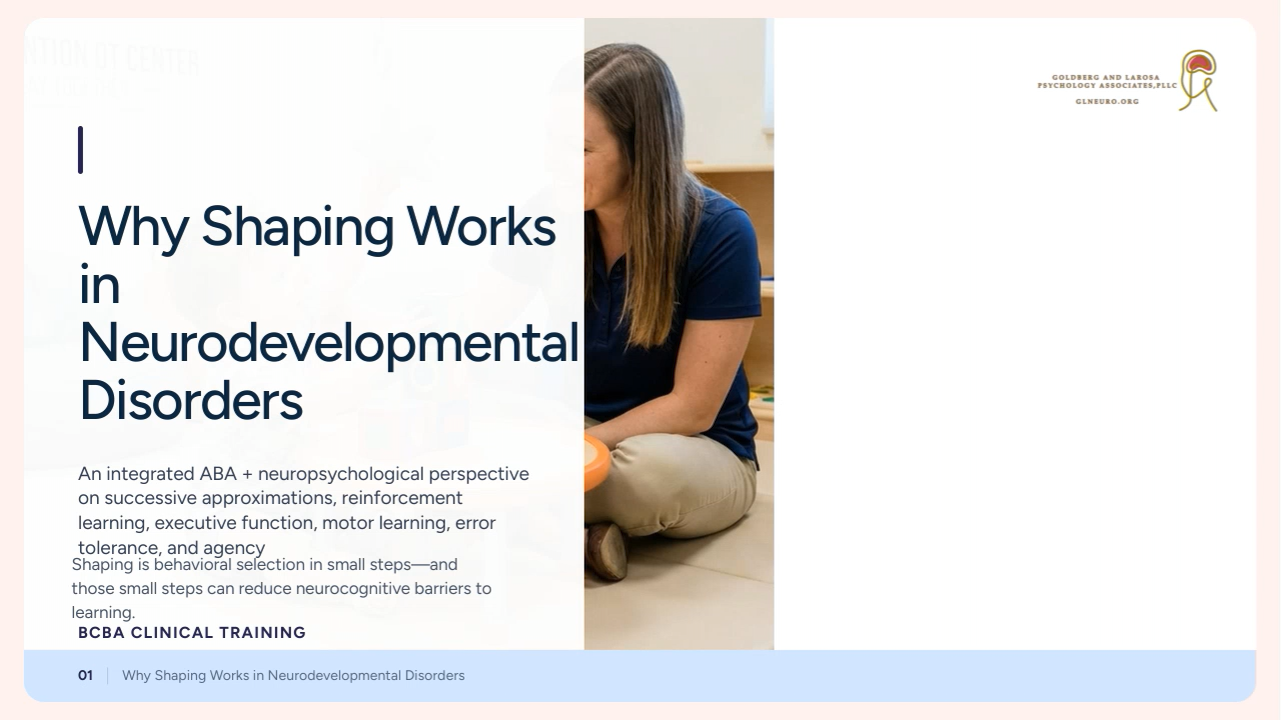
Shaping is a foundational behavior-analytic procedure used to develop new skills by reinforcing successive approximations toward a target behavior. A neuropsychology-informed approach adds another layer by considering how attention, executive functioning, learning, motor planning, frustration tolerance, and other individual differences may affect how a learner progresses through those approximations.
This training reviews shaping from both behavior-analytic and neuropsychology-informed perspectives. Participants will examine how to identify an appropriate terminal behavior, select realistic intermediate approximations, and adjust reinforcement criteria based on the learner’s current performance and rate of progress.
The webinar also considers why some learners may require smaller approximations, additional repetition, reduced task demands, or more gradual changes in reinforcement criteria to maintain successful responding. Particular attention is given to how cognitive load, motor demands, attention, executive functioning, and frustration tolerance may affect performance during shaping procedures.
The emphasis is on using shaping systematically while remaining responsive to the learner’s cognitive, behavioral, developmental, and performance profile.
Format: On-demand webinar
Length: Approximately 28 minutes
CEUs: 0.5 General/Learning BACB CEU
Presenter: Vanetta R. LaRosa, Ph.D., BCBA-D, LBA, Licensed Psychologist
Audience: BCBAs, BCBA-Ds, BCaBAs, RBTs, clinical supervisors, behavior analysts, and other professionals using behavior-analytic teaching strategies with children, adolescents, or adults
Learning Objectives
- Define shaping and explain the role of successive approximations in developing new behavior.
- Identify appropriate intermediate approximations based on a learner’s current performance and terminal behavioral goal.
- Describe how attention, executive functioning, learning, motor planning, cognitive load, and frustration tolerance may influence the shaping process.
- Explain how reinforcement criteria can be systematically adjusted as the learner progresses toward the target behavior.
- Identify when smaller approximations, additional repetition, or modification of task demands may improve successful responding during shaping.
Disclaimer
This training is for professional education only. Assessment instruments are discussed only at the level of general clinical purpose and treatment-planning implications. No proprietary test items, scoring forms, protocols, stimulus materials, rating-scale items, or administration procedures are reproduced. Participants should consult official publishers, manuals, and professional standards for authorized test administration, scoring, and interpretation.
Video
-
Video
28:16 -
Quiz
Student Ratings & Reviews

Contact
We’re here to help you understand the next step
Reach out if you would like to discuss a referral question, the type of evaluation you may need, scheduling, or whether our practice is the right fit.