
Beyond the Topography: Brain Systems Behind Stimming, Rigidity, and Emotional Dysregulation
About Course
A brain-based ABA webinar on sensory processing, arousal regulation, emotional control, and treatment planning.
Why does a person flap, rock, pace, hum, spin, repeat phrases, seek pressure, or become intensely dysregulated when the environment changes? Why can excitement, anxiety, frustration, and sensory overload sometimes look behaviorally similar? And why do some learners respond well to an intervention in one setting but struggle to generalize that same skill somewhere else?
This webinar helps BCBAs look beneath the visible behavior and understand the neuropsychological systems that shape stimming, repetitive behavior, sensory seeking, rigidity, attention shifting, and emotional regulation in autism.
Stimming is explored as a clinically important window into arousal regulation, sensory modulation, motor rhythm, predictability, emotional control, and self-organization. Participants examine how repetitive movement, sound, sensory seeking, and insistence on sameness may reflect the brain’s attempt to regulate input, manage uncertainty, organize action, or stabilize emotion.
The training translates these concepts into ABA-relevant clinical decisions, including functional assessment, reinforcement systems, antecedent strategies, prompting, replacement skills, parent training, generalization, and treatment planning for complex neurodevelopmental profiles.
Format: 3-part on-demand video course
Length: 68 minutes
CEUs: 1.25 BACB CEU
Presenter: Dr. Vanetta LaRosa
Audience: BCBAs, BCaBAs, behavior analysts, clinical supervisors, autism service providers, school-based behavior consultants, psychologists, and interdisciplinary professionals supporting autistic learners
Included Sessions
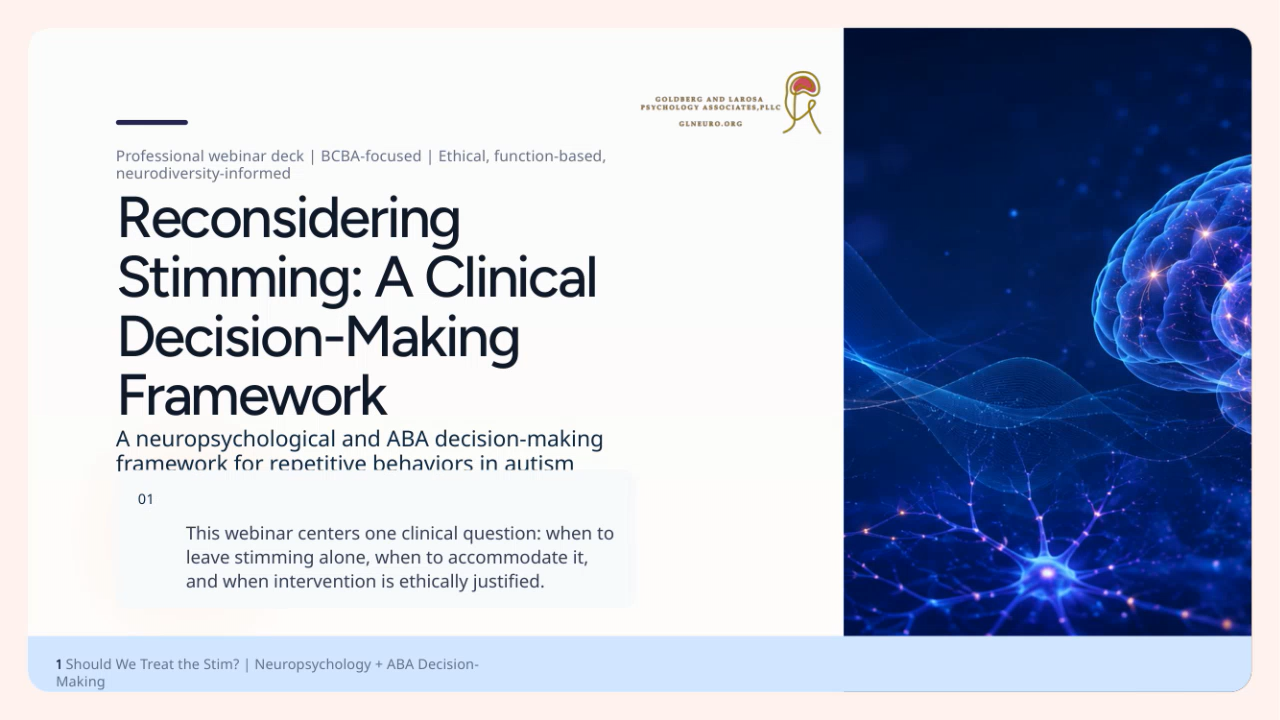
- Part 1: Reconsidering Stimming: A Clinical Decision-Making Framework
- Part 2: Stimming Through a Neuropsychological Lens
- Part 3: The Brain Behind Stimming
Learning Objectives
- Describe stimming as a behavior that may support sensory regulation, arousal regulation, attention, communication, predictability, or motor organization.
- Differentiate the topography of a repetitive behavior from its function in a specific context.
- Identify neuropsychological mechanisms that may contribute to stimming, including sensory processing differences, corticostriatal loops, motor circuitry, cerebellar rhythm, autonomic arousal, and executive control demands.
- Use functional assessment to evaluate whether stimming is safe, adaptive, distress-related, regulatory, or meaningfully interfering with daily functioning.
- Apply an ethical decision-making framework to determine when to accept, accommodate, modify, or intervene with repetitive behavior.
- Design ABA supports that preserve the regulatory function of behavior, including environmental modifications, sensory alternatives, communication supports, transition preparation, and safer replacement responses.
- Write treatment goals that prioritize safety, access, communication, self-regulation, dignity, and quality of life rather than appearance-based reduction.
Disclaimer
This training is for professional education only. Assessment instruments are discussed only at the level of general clinical purpose and treatment-planning implications. No proprietary test items, scoring forms, protocols, stimulus materials, rating-scale items, or administration procedures are reproduced. Participants should consult official publishers, manuals, and professional standards for authorized test administration, scoring, and interpretation.
Beyond the Topography: Brain Systems Behind Stimming, Rigidity, and Emotional Dysregulation
-
Part 1: Reconsidering Stimming: A Clinical Decision-Making Framework
33:27 -
Part 2: Stimming Through a Neuropsychological Lens
25:16 -
Part 3: The Brain Behind Stimming
10:23 -
Quiz
Contact
We’re here to help you understand the next step
Reach out if you would like to discuss a referral question, the type of evaluation you may need, scheduling, or whether our practice is the right fit.