Neuropsychology-Informed Prompt Dependency
About Course
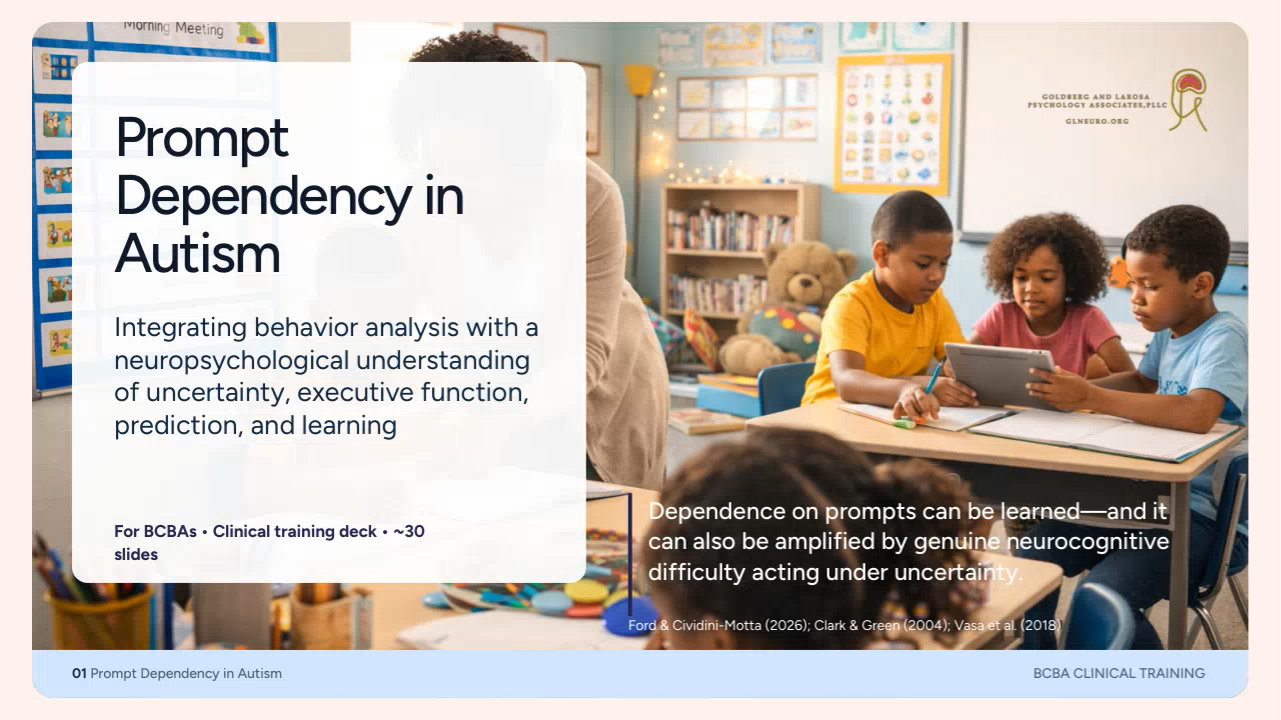
Prompts can be essential for helping learners acquire new skills, but when assistance is not systematically faded, responding may become dependent on the prompt rather than the naturally occurring cue. Prompt dependency can interfere with independence, generalization, maintenance, and long-term skill development.
This training examines prompt dependency from both behavior-analytic and neuropsychology-informed perspectives. Participants will explore factors that may contribute to persistent reliance on prompts, including reinforcement history, stimulus control, attention, executive functioning, processing demands, response initiation, and difficulty transferring control from instructional prompts to naturally occurring environmental cues.
The course reviews practical strategies for recognizing prompt dependency, selecting appropriate levels and types of prompting, fading assistance systematically, and transferring stimulus control to the cues that should ultimately guide independent behavior.
Emphasis is placed on balancing adequate instructional support with meaningful opportunities for independent responding. Participants will also consider how overly rapid prompting, inconsistent fading, excessive verbal assistance, or predictable prompt sequences may unintentionally make prompts part of the expected response pattern.
Format: On-demand webinar
Length: Approximately 28 minutes
CEUs: 0.5 General/Learning BACB CEU
Presenter: Vanetta R. LaRosa, Ph.D., BCBA-D, LBA, Licensed Psychologist
Audience: BCBAs, BCBA-Ds, BCaBAs, RBTs, clinical supervisors, behavior analysts, and other professionals providing skill-acquisition interventions to children, adolescents, or adults
Learning Objectives
- Define prompt dependency and identify patterns that may indicate excessive reliance on instructional assistance.
- Identify behavioral and neuropsychological factors that may contribute to difficulty responding independently, including stimulus-control history, attention, executive functioning, processing demands, and response initiation.
- Describe strategies for systematically fading prompts and transferring stimulus control to naturally occurring cues.
- Differentiate appropriate instructional support from prompting practices that may inadvertently maintain prompt-dependent responding.
- Identify prompting patterns that may reduce opportunities for independent responding, including overly rapid prompting, excessive verbal assistance, inconsistent fading, and predictable prompt sequences.
Disclaimer
This training is for professional education only. Assessment instruments are discussed only at the level of general clinical purpose and treatment-planning implications. No proprietary test items, scoring forms, protocols, stimulus materials, rating-scale items, or administration procedures are reproduced. Participants should consult official publishers, manuals, and professional standards for authorized test administration, scoring, and interpretation.
Video
-
Video
29:12 -
Quiz
Student Ratings & Reviews

Contact
We’re here to help you understand the next step
Reach out if you would like to discuss a referral question, the type of evaluation you may need, scheduling, or whether our practice is the right fit.