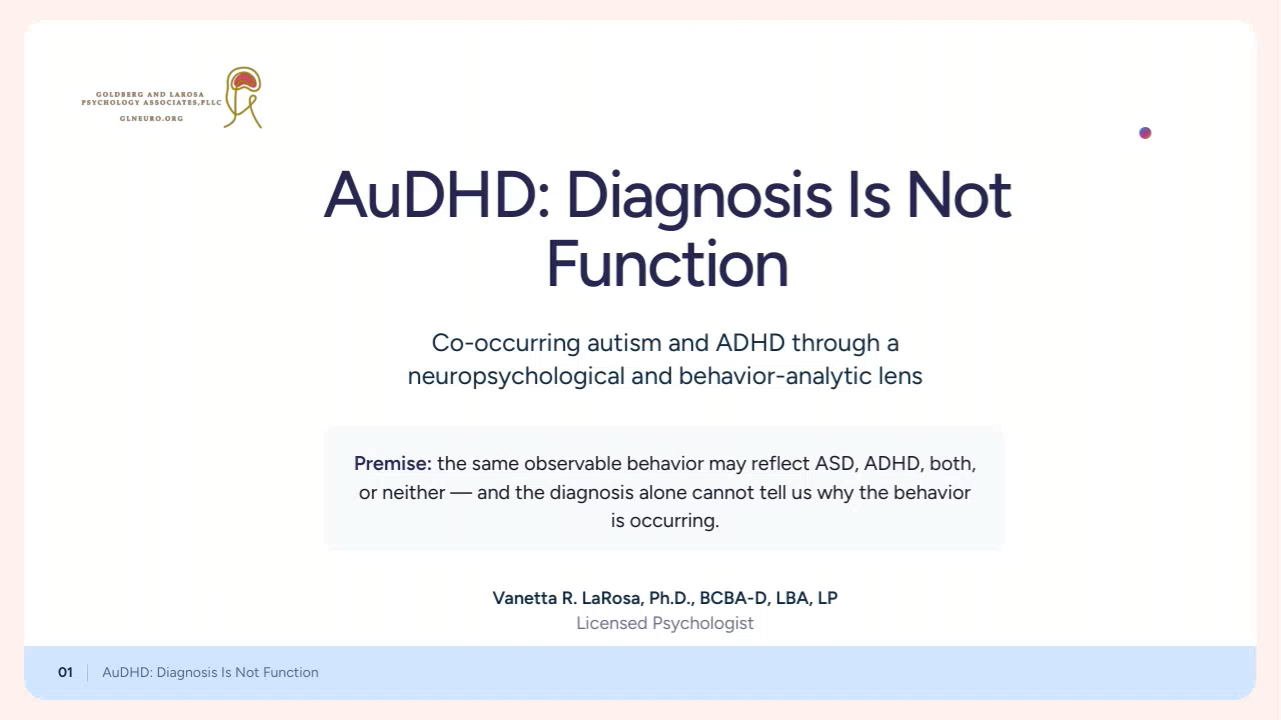
AuDHD: Diagnosis Does Not Equal Function
About Course
“AuDHD” has become an increasingly popular term for the co-occurrence of Autism Spectrum Disorder and ADHD. But what does the term mean clinically, and what should it mean for behavior analysts?
This CEU webinar examines AuDHD from a neuropsychological and behavior-analytic perspective, with one central principle: diagnosis does not equal function.
Individuals with ASD and ADHD may show overlapping patterns such as inattention, impulsivity, emotional dysregulation, rigidity, difficulty with transitions, and executive-function weaknesses. However, similar-looking behaviors may occur in individuals with ASD, ADHD, both diagnoses, or neither, and the same observable behavior may serve very different functions across individuals and environments.
For behavior analysts, diagnostic information can broaden the assessment lens and identify variables that may warrant closer evaluation, but it should not replace functional assessment or individualized case conceptualization. This training examines how diagnostic and neuropsychological information can be used to generate better clinical questions without assuming that a diagnosis explains why a behavior is occurring.
Using current peer-reviewed literature, the webinar reviews the overlap between ASD and ADHD, the growing use of the term AuDHD, and practical implications for ABA assessment and treatment planning. Participants will consider how executive-function demands, environmental variables, reinforcement contingencies, medication-related factors, and other individual differences may influence performance and intervention response.
The course also addresses collaboration, referral, medication considerations, and scope of practice, helping BCBAs use diagnostic information appropriately while maintaining function-based, individualized, and behavior-analytic decision-making.
Format: On-demand webinar
CEUs: 0.5 BACB CEU
Presenter: Vanetta R. LaRosa, Ph.D., BCBA-D, LBA, Licensed Psychologist
Audience: BCBAs, BCBA-Ds, BCaBAs, psychologists, school psychologists, educators, clinical supervisors, and other professionals working with individuals with ASD, ADHD, or both
Learning Objectives
- Describe what is meant by the term AuDHD and explain its relationship to the separate diagnoses of Autism Spectrum Disorder and ADHD.
- Identify at least three areas of behavioral or neuropsychological overlap between ASD and ADHD, including attention, impulsivity, emotional regulation, cognitive flexibility, or executive functioning.
- Explain why diagnosis alone cannot determine the function, cause, or maintaining variables of an individual behavior.
- Differentiate between using diagnostic information to generate assessment hypotheses and using a diagnosis as an explanation for behavior.
- Describe how executive-function demands, environmental variables, reinforcement contingencies, and other individual factors may influence behavior and treatment response.
- Identify practical ways BCBAs can incorporate information about ASD, ADHD, and executive functioning into individualized assessment and treatment planning while remaining within scope of practice.
Disclaimer
This training is for professional education only. Assessment instruments are discussed only at the level of general clinical purpose and treatment-planning implications. No proprietary test items, scoring forms, protocols, stimulus materials, rating-scale items, or administration procedures are reproduced. Participants should consult official publishers, manuals, and professional standards for authorized test administration, scoring, and interpretation.
Video
-
Video
35:40 -
Quiz
Student Ratings & Reviews

Contact
We’re here to help you understand the next step
Reach out if you would like to discuss a referral question, the type of evaluation you may need, scheduling, or whether our practice is the right fit.