ASD Assessment Tools for ABA Practice
About Course
A Practical CEU Webinar for BCBAs, Behavior Analysts, Supervisors, and Graduate Students
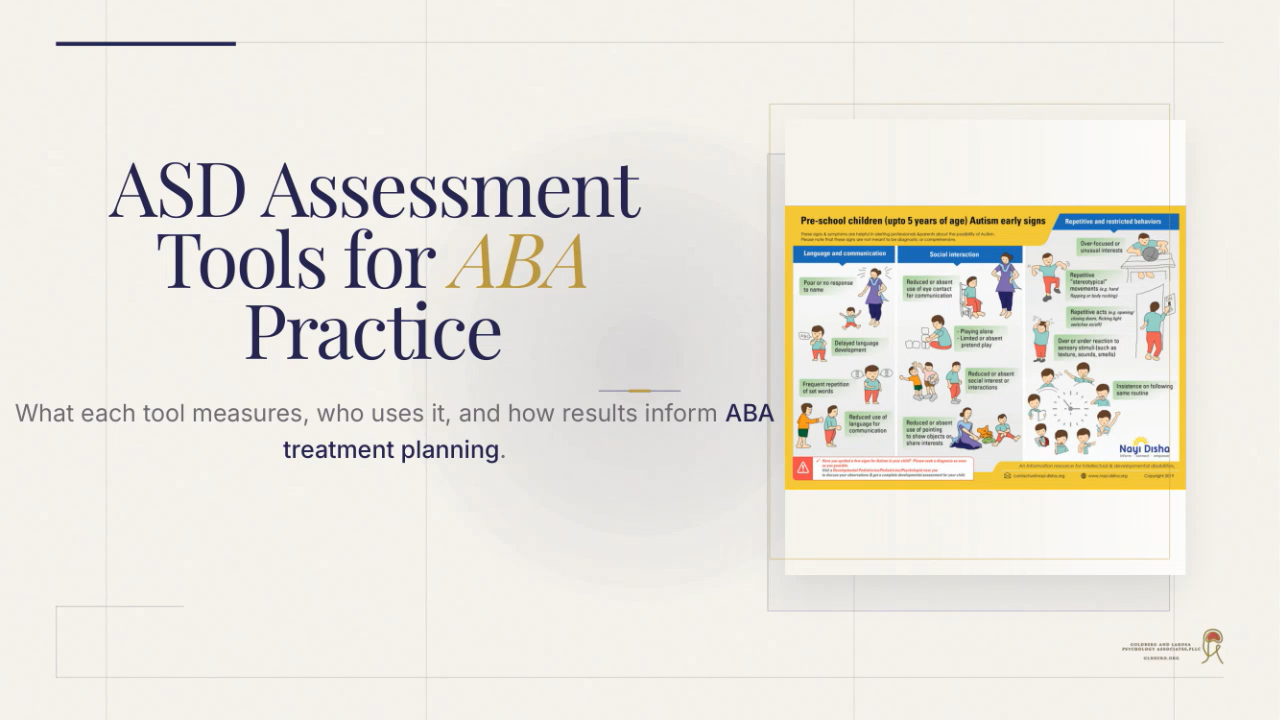
This CEU webinar provides a practical overview of commonly used autism and ABA assessment tools, with a focus on how assessment data can guide meaningful treatment planning. The training is designed for behavior analysts who want to better understand the role of diagnostic, developmental, adaptive, behavioral, language, sensory, and skills-based assessments in autism services.
Participants will review key tools such as the ADOS-2, ADI-R, SRS-2, ASRS, CARS-2, SCQ, GARS-3, PDDBI, Vineland-3, ABAS-3, FAST, MAS, QABF, FAI, VB-MAPP, ABLLS-R, AFLS, EFL, PEAK, BRIEF-2, BASC-3, Conners-4, and related language, sensory, and functional assessment measures.
The webinar emphasizes what each tool measures, who typically completes it, when it may be useful, and how findings can be translated into ABA programming decisions. Special attention is given to the distinction between tools used for diagnosis, tools used for treatment planning, and tools used for ongoing clinical decision-making.
This training does not teach participants to independently diagnose autism or administer restricted psychological instruments without appropriate training, supervision, or credentialing. Instead, it helps ABA professionals become stronger consumers of assessment data, better collaborators with psychologists and interdisciplinary teams, and more effective treatment planners.
By the end of the webinar, participants will be able to identify common autism and ABA assessment tools, explain their purpose, recognize how results inform intervention planning, and select assessment approaches that support individualized, ethical, and function-based ABA services.
Format: On-demand webinar
Length: 1 hour, 20 minutes
CEUs: 1.5 BACB CEUs
Presenter: Dr. Vanetta LaRosa
Audience: BCBAs, BCBA-Ds, BCaBAs, behavior analysts, clinical supervisors, ABA program directors, school-based behavior consultants, graduate students, and interdisciplinary professionals involved in autism assessment, treatment planning, and ABA service delivery
Learning Objectives
- Identify commonly used autism and ABA assessment tools, including diagnostic, developmental, adaptive, behavioral, language, sensory, executive-function, and skills-based measures.
- Describe the general purpose of tools such as the ADOS-2, ADI-R, SRS-2, ASRS, CARS-2, SCQ, GARS-3, PDDBI, Vineland-3, ABAS-3, FAST, MAS, QABF, FAI, VB-MAPP, ABLLS-R, AFLS, EFL, PEAK, BRIEF-2, BASC-3, and Conners-4.
- Differentiate assessment tools used primarily for diagnosis from tools used for ABA treatment planning, functional assessment, skills assessment, progress monitoring, and ongoing clinical decision-making.
- Explain how assessment findings can inform ABA programming decisions, including goal selection, antecedent strategies, reinforcement planning, prompting, accommodations, communication supports, adaptive skill development, and generalization planning.
- Recognize who typically completes different assessment measures and when collaboration with psychologists, school teams, speech-language pathologists, occupational therapists, physicians, caregivers, or other professionals may be needed.
- Use assessment data ethically within the behavior analyst’s scope of competence, without independently diagnosing autism or administering restricted psychological instruments without appropriate credentials, training, or supervision.
- Select assessment approaches that support individualized, ethical, function-based, and clinically meaningful ABA services for autistic learners and individuals with related developmental needs.
Disclaimer
This training is for professional education only. Assessment instruments are discussed only at the level of general clinical purpose and treatment-planning implications. No proprietary test items, scoring forms, protocols, stimulus materials, rating-scale items, or administration procedures are reproduced. Participants should consult official publishers, manuals, and professional standards for authorized test administration, scoring, and interpretation.
ASD Assessment Tools for ABA Practice
-
Video
01:18:39 -
Quiz
Contact
We’re here to help you understand the next step
Reach out if you would like to discuss a referral question, the type of evaluation you may need, scheduling, or whether our practice is the right fit.