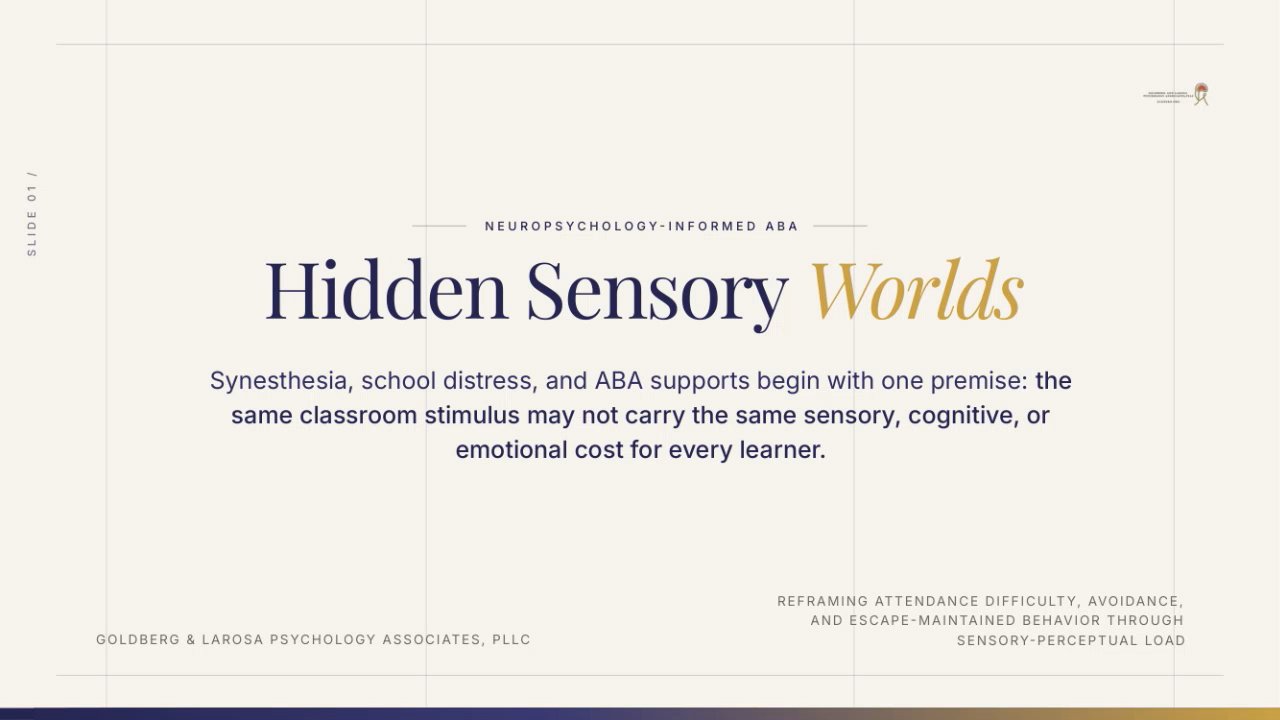
Hidden Sensory Worlds: Synesthesia, School Distress, and Neuropsychology-Informed ABA Supports
About Course
What if a student’s school refusal is not refusal at all, but a response to a world that feels louder, brighter, more layered, and more neurologically demanding than adults realize?
This fast, eye-opening webinar explores how neurodivergent students may experience school distress through hidden sensory-perceptual differences, including synesthesia, sensory hyper-responsiveness, anxiety, executive-function load, and environmental mismatch. Using recent research on neurodivergent school attendance difficulties and peer-reviewed literature on synesthesia and autism, this training helps BCBAs and related professionals think more deeply about avoidance, distress, and classroom participation.
Rather than viewing school avoidance only as escape from work or noncompliance, participants will learn how sensory-perceptual load can function as a powerful antecedent condition. The webinar connects neuropsychological concepts to practical ABA supports, including environmental modification, antecedent assessment, learner self-report, sensory accommodations, and ethical interpretation of behavior.
This concise training is ideal for BCBAs, school-based clinicians, behavior specialists, psychologists, educators, and supervisors who want a fresh, clinically meaningful way to understand neurodivergent distress in school settings.
Format: On-demand webinar
Length: 30 minutes
CEUs: 0.5 BACB CEU
Presenter: Dr. Vanetta LaRosa
Audience: BCBAs, BCBA-Ds, BCaBAs, school-based clinicians, behavior specialists, psychologists, educators, supervisors, and professionals supporting neurodivergent students with school distress, avoidance, sensory differences, anxiety, or classroom participation challenges
Learning Objectives
- Explain how school distress may reflect environmental mismatch rather than simple refusal.
- Describe synesthesia as one example of hidden sensory-perceptual processing differences.
- Identify how sensory load, anxiety, executive-function demands, and classroom stimuli may contribute to avoidance or reduced participation.
- Apply neuropsychology-informed ABA thinking to antecedent assessment, environmental modification, sensory accommodations, and support planning.
- Use learner self-report and observable data to better understand distress, avoidance, and classroom participation.
- Reframe noncompliance through a more ethical, individualized, and neurologically informed lens.
Disclaimer
This training is for professional education only. Assessment instruments are discussed only at the level of general clinical purpose and treatment-planning implications. No proprietary test items, scoring forms, protocols, stimulus materials, rating-scale items, or administration procedures are reproduced. Participants should consult official publishers, manuals, and professional standards for authorized test administration, scoring, and interpretation.
Hidden Sensory Worlds: Synesthesia, School Distress, and Neuropsychology-Informed ABA Supports
-
Video
29:20 -
Quiz
Contact
We’re here to help you understand the next step
Reach out if you would like to discuss a referral question, the type of evaluation you may need, scheduling, or whether our practice is the right fit.