Biological Bases of Behavior in Neurodevelopmental Conditions
About Course
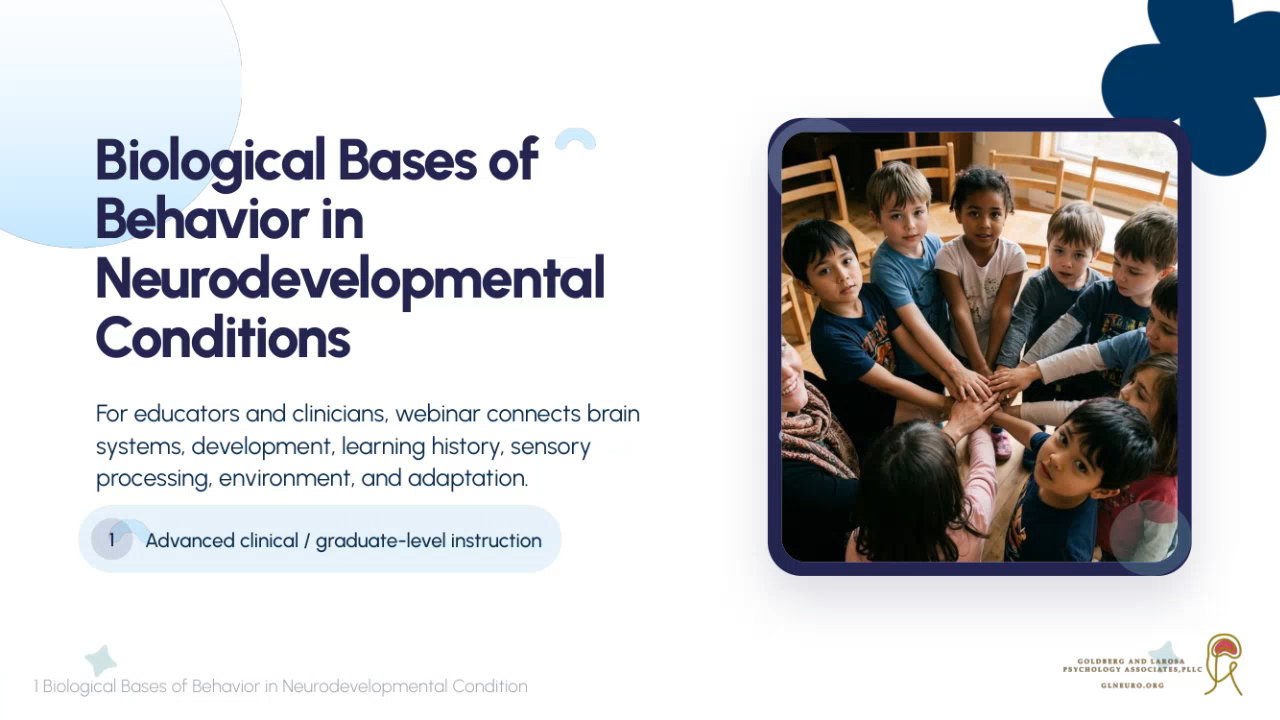
This on-demand webinar provides an advanced, clinically oriented introduction to the biological and neuropsychological foundations of behavior in neurodevelopmental conditions. Designed for BCBAs, educators, psychologists, and related clinicians, the training connects brain systems, development, learning history, sensory processing, environmental context, and adaptation to the behavioral patterns often seen in autism, ADHD, learning disorders, and related neurodevelopmental presentations.
The course reviews major brain-behavior systems, including frontal control networks, limbic and diencephalic systems, neuronal communication, electrical signaling, neurotransmitter regulation, sensory and motor systems, memory and learning networks, and basal ganglia-dopamine pathways. Participants will consider how these systems influence attention, arousal, emotion regulation, impulsivity, rigidity, motivation, learning, repetitive behavior, and behavioral escalation.
A major emphasis is placed on moving beyond diagnosis alone. The webinar explains why the same outward behavior can arise from different neuropsychological pathways and why assessment should consider mechanism, context, and functional pathway, not just symptom labels. Participants will learn to ask how cognition, language, attention, executive function, sensory processing, motor planning, adaptive functioning, medical variables, sleep, stress, and learning history may interact to shape behavior.
The webinar translates biological and neuropsychological concepts into practical ABA decision-making. Participants will examine implications for functional assessment, antecedent design, reinforcement selection, prompting, skill acquisition, generalization, behavior change hypotheses, assessment interpretation, and respectful clinical language that avoids blame, fixed-deficit assumptions, or single-cause explanations.
Format: On-demand webinar
Length: 32 minutes
CEUs: 0.5 BACB CEU
Presenter: Dr. Vanetta LaRosa
Audience: BCBAs, BCaBAs, behavior analysts, educators, psychologists, clinical supervisors, school-based consultants, and professionals supporting individuals with autism, ADHD, learning disorders, and related neurodevelopmental conditions
Learning Objectives
- Describe how brain systems, developmental processes, learning history, sensory processing, and environmental context interact to influence behavior.
- Identify major biological systems relevant to behavior, including frontal systems, limbic and diencephalic systems, basal ganglia circuits, sensory and motor systems, neurotransmitter systems, and arousal networks.
- Explain how biological variables can influence attention, motivation, emotional regulation, impulse control, cognitive flexibility, learning, and behavioral escalation.
- Differentiate diagnosis-based interpretation from mechanism-focused case formulation in autism, ADHD, learning disorders, and related neurodevelopmental profiles.
- Recognize that the same observable behavior may reflect different pathways, including sensory overload, executive dysfunction, anxiety, motor demands, working memory limits, arousal dysregulation, or reinforcement history.
- Apply neuroscience-informed ABA concepts to functional assessment, antecedent strategies, reinforcement selection, prompting, skill acquisition, generalization, and behavior change planning.
- Use respectful clinical language that describes neurodevelopmental differences, processing profiles, support needs, and functional impact without reducing behavior to blame or fixed deficits.
Disclaimer
This training is for professional education only. Assessment instruments are discussed only at the level of general clinical purpose and treatment-planning implications. No proprietary test items, scoring forms, protocols, stimulus materials, rating-scale items, or administration procedures are reproduced. Participants should consult official publishers, manuals, and professional standards for authorized test administration, scoring, and interpretation.
Biological Bases of Behavior in Neurodevelopmental Conditions
-
Video
32:50 -
Quiz
Contact
We’re here to help you understand the next step
Reach out if you would like to discuss a referral question, the type of evaluation you may need, scheduling, or whether our practice is the right fit.