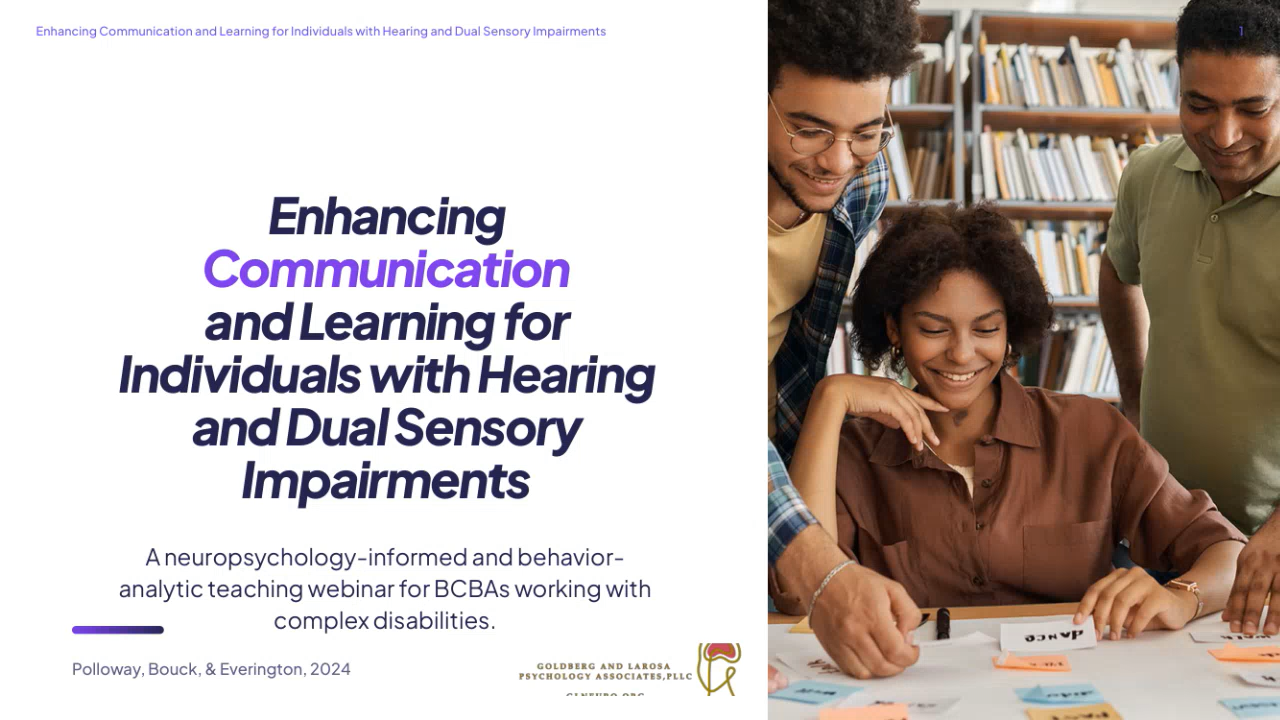
Enhancing Communication and Learning for Individuals with Hearing and Dual Sensory Impairments
About Course
A neuropsychology-informed and behavior-analytic teaching webinar for BCBAs and interdisciplinary professionals working with complex disabilities
This on-demand webinar examines how hearing loss and dual sensory impairments affect communication, learning, attention, social interaction, behavior, and access to instruction. The training is designed for professionals who support individuals with hearing impairment, combined vision and hearing challenges, and complex developmental or neurodevelopmental profiles.
The webinar integrates neuropsychological and behavior-analytic perspectives to help clinicians and educators understand how sensory access shapes learning. Participants will consider how reduced or inconsistent auditory and visual input can affect language development, concept formation, imitation, joint attention, memory, emotional regulation, social understanding, and independence.
Rather than viewing communication or behavioral challenges in isolation, the training emphasizes how sensory processing demands, environmental barriers, and limited access to incidental learning can influence skill acquisition and behavior.
Special attention is given to practical intervention planning. Participants will examine how to adapt instructional design, prompting, reinforcement systems, communication supports, environmental arrangements, visual and tactile cues, task analysis, and generalization programming for learners with sensory impairments.
The webinar also addresses the ethical importance of not misinterpreting reduced access, delayed responding, atypical communication, or inconsistent performance as noncompliance, lack of motivation, or inability.
The focus is on helping BCBAs and related professionals collaborate more effectively with families, teachers, speech-language pathologists, audiologists, occupational therapists, vision specialists, and school teams. Participants will leave with a stronger framework for supporting communication, learning, self-advocacy, adaptive behavior, and meaningful participation for individuals with hearing and dual sensory impairments.
Format: On-demand webinar
Length: Approximately 53 minutes
CEUs: 1 BACB CEU
Presenter: Dr. Vanetta LaRosa
Audience: BCBAs, BCBA-Ds, BCaBAs, behavior analysts, clinical supervisors, ABA program directors, school-based behavior consultants, special educators, teachers of students with hearing or visual impairments, speech-language pathologists, psychologists, school psychologists, LMHCs, social workers, and related professionals supporting individuals with sensory, communication, developmental, or neurodevelopmental needs
Learning Objectives
- Analyze sensory, communication, motor, medical, and neuropsychological variables that may affect learning and behavior in complex disabilities.
- Differentiate skill deficits from access or performance constraints related to stimulus detectability, response effort, processing speed, fatigue, pain, device status, seizures, or communication modality.
- Describe how hearing aids, FM systems, AAC, tactile cues, object cues, visual supports, and multimodal prompting can support communication and participation when matched to the learner’s sensory and motor profile.
- Apply an expanded FBA framework that includes auditory, visual, tactile, motor, medical, neurological, and communication-access variables.
- Design functional communication systems that allow learners to request, reject, protest, ask for help, ask for repetition, request a break, repair communication, and express discomfort.
- Use access-first intervention strategies for learners with hearing loss, deaf-blindness, dual sensory impairment, cerebral palsy, epilepsy, hydrocephalus, spina bifida, and related complex profiles.
- Develop ABA goals and data systems that measure regulation, engagement, communication efficiency, device tolerance, response form, cue access, reinforcement access, and treatment responsiveness over time.
Disclaimer
This training is for professional education only. Assessment instruments are discussed only at the level of general clinical purpose and treatment-planning implications. No proprietary test items, scoring forms, protocols, stimulus materials, rating-scale items, or administration procedures are reproduced. Participants should consult official publishers, manuals, and professional standards for authorized test administration, scoring, and interpretation.
Enhancing Communication and Learning for Individuals with Hearing and Dual Sensory Impairments
-
Video
53:07 -
Quiz
Contact
We’re here to help you understand the next step
Reach out if you would like to discuss a referral question, the type of evaluation you may need, scheduling, or whether our practice is the right fit.