Neuropsychological Assessment and ABA Decision-Making in Autism and Neurodevelopmental Disorders
About Course
A 3-Part Webinar Series for BCBAs
This 3-part on-demand webinar series helps behavior analysts understand how neuropsychological assessment findings can strengthen ABA treatment planning for autistic learners and individuals with related neurodevelopmental profiles. The series emphasizes that assessment should not be viewed as a single score, label, or isolated test result, but as an integrated clinical profile that connects diagnosis, cognitive functioning, adaptive behavior, language, executive function, sensory processing, emotional regulation, and real-world behavior.
Participants will learn how comprehensive ASD assessment can clarify not only whether diagnostic criteria are met, but also how a learner processes information, communicates, tolerates demands, responds to transitions, retains new skills, interprets social information, and functions across home, school, and community settings. The series highlights how assessment data can help BCBAs move from general treatment planning to more individualized, developmentally informed, and clinically precise intervention design.
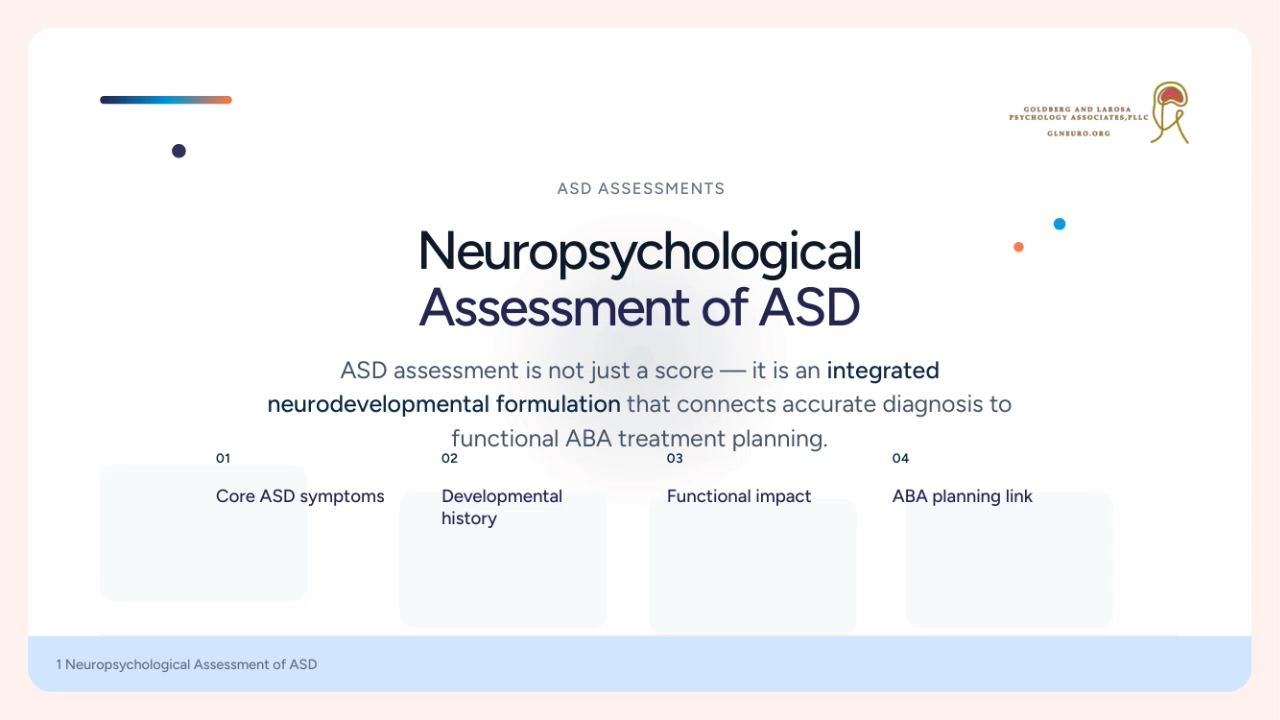
The first session focuses on neuropsychological assessment of ASD, including the role of developmental history, direct observation, caregiver and teacher reports, adaptive behavior measures, cognitive and language testing, sensory assessment, executive function tools, emotional and behavioral measures, and differential diagnosis. Participants will review why ASD diagnosis requires converging evidence rather than reliance on one test alone.
The second session examines how NEPSY-II findings can help BCBAs move from identifying the function of behavior to understanding the conditions under which behavior is most likely to occur. Participants will consider how attention, inhibition, shifting, language processing, working memory, memory, learning, and social perception can affect task demands, transitions, verbal instructions, prompt dependence, escape behavior, and instructional design.
The third session reviews neuropsychological assessment tools that are especially relevant for ABA treatment planning, including tools related to autism symptoms, executive function, attention, adaptive behavior, language, memory, social cognition, emotional functioning, and cognitive flexibility. The course emphasizes ethical boundaries, collaboration with licensed clinicians, and the appropriate use of assessment findings to inform ABA programming without overstepping diagnostic scope.
Format: 3-part webinar series
Length: 3 hours, 20 minutes
CEUs: 4 BACB CEU
Presenter: Dr. Vanetta LaRosa
Audience: BCBAs, BCaBAs, behavior analysts, clinical supervisors, school-based behavior consultants, autism service providers, and professionals involved in ABA treatment planning for autistic learners and individuals with neurodevelopmental conditions
Included Sessions
- Part 1: Neuropsychological Assessment of ASD
- Part 2: From Function to Conditions: Integrating NEPSY-II Findings into ABA Decision-Making
- Part 3: Neuropsychological Assessment Tools for BCBAs
Learning Objectives
- Describe why ASD assessment requires converging evidence from developmental history, direct observation, rating scales, adaptive functioning, cognitive and language profiles, sensory features, and differential diagnosis.
- Identify major assessment domains that may inform ABA treatment planning, including adaptive behavior, communication, executive function, attention, memory, social cognition, sensory processing, and emotional regulation.
- Explain how assessment findings can clarify treatment intensity, communication supports, reinforcement systems, caregiver training needs, adaptive goals, and intervention priorities.
- Use NEPSY-II findings to identify the conditions under which behavior is more likely to break down, including verbal load, working memory demands, processing speed, transitions, inhibition demands, and cognitive flexibility requirements.
- Differentiate escape from work from escape related to cognitive overload, language demands, memory limitations, processing speed, or weak self-regulation.
- Translate neuropsychological findings into ABA strategies such as simplifying language, using visual supports, externalizing working memory, slowing task pace, modifying antecedents, shaping delay tolerance, and explicitly teaching flexibility.
- Recognize ethical boundaries for BCBAs when using or interpreting assessment data, including when collaboration with licensed psychologists, neuropsychologists, or other clinicians is required.
Disclaimer
This training is for professional education only. Assessment instruments are discussed only at the level of general clinical purpose and treatment-planning implications. No proprietary test items, scoring forms, protocols, stimulus materials, rating-scale items, or administration procedures are reproduced. Participants should consult official publishers, manuals, and professional standards for authorized test administration, scoring, and interpretation.
Neuropsychological Assessment and ABA Decision-Making in Autism and Neurodevelopmental Disorders
-
Part 1: Neuropsychological Assessment of ASD
29:02 -
Part 2: From Function to Conditions: Integrating NEPSY-II Findings into ABA Decision-Making
01:05:12 -
Part 3: Neuropsychological Assessment Tools for BCBAs
01:44:16 -
Quiz
Contact
We’re here to help you understand the next step
Reach out if you would like to discuss a referral question, the type of evaluation you may need, scheduling, or whether our practice is the right fit.