Executive Dysfunction in Autism
About Course
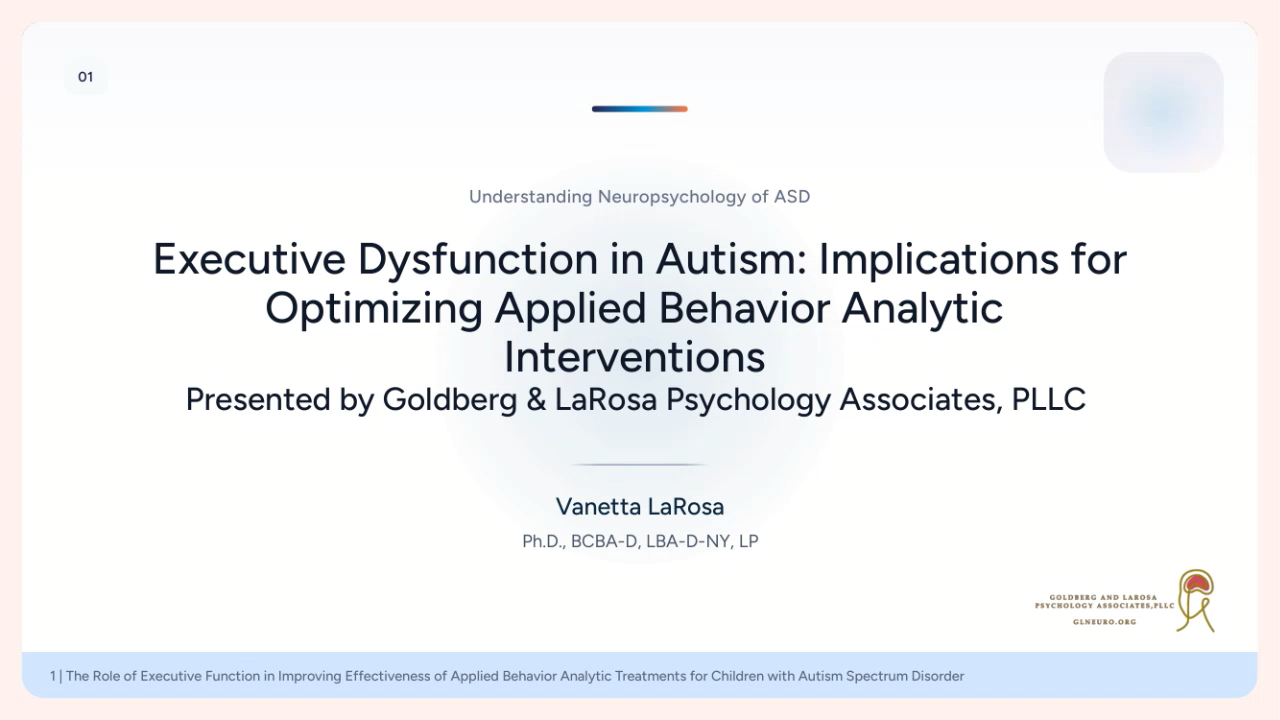
This on-demand webinar helps behavior analysts understand the role of executive function in autism and how executive dysfunction can affect the effectiveness of applied behavior analytic interventions. The course emphasizes that skills such as planning, flexibility, inhibition, working memory, initiation, self-monitoring, organization, and emotional control are central to learning, adaptive behavior, and treatment response.
Participants will examine how executive functioning differences can contribute to rigidity, perseveration, difficulty with transitions, inconsistent responding, task initiation problems, weak self-monitoring, impulsivity, and challenges with generalization. The webinar explains why these patterns should not be viewed only as noncompliance or lack of motivation, but may reflect underlying neuropsychological vulnerabilities that need to be measured and addressed directly.
The course reviews neuropsychological assessment tools that can clarify executive functioning profiles in children with autism, including the NEPSY-II, D-KEFS, Executive Control Battery, and Behavior Rating Inventory of Executive Function. These tools are discussed as ways to identify specific areas of executive dysfunction, including inhibition, shifting, cognitive flexibility, planning, sequencing, working memory, generativity, perseveration, stereotypy, inertia, and executive discontrol.
The webinar connects assessment findings to ABA treatment planning. Participants will consider how executive function data can inform goal selection, antecedent strategies, instructional design, prompting, reinforcement systems, task analysis, rule shifting, response inhibition, flexible thinking, and generalization programming. The focus is on translating neuropsychological findings into practical ABA goals that improve learning, regulation, independence, and durable behavior change.
Format: On-demand webinar
Length: 1 hour 16 minutes
CEUs: 1.5 BACB CEUs
Presenter: Dr. Vanetta LaRosa
Audience: BCBAs, BCaBAs, behavior analysts, clinical supervisors, school-based behavior consultants, educators, and professionals supporting autistic learners with executive functioning, flexibility, regulation, learning, or adaptive behavior challenges
Learning Objectives
- Describe the role of executive function in learning, behavior, self-regulation, and ABA treatment response in autism.
- Identify executive functioning skills that may affect intervention outcomes, including planning, flexibility, inhibition, working memory, initiation, organization, emotional control, and self-monitoring.
- Recognize how executive dysfunction may contribute to rigidity, perseveration, transition difficulty, impulsivity, inconsistent responding, and limited generalization.
- Explain how tools such as the NEPSY-II, D-KEFS, Executive Control Battery, and BRIEF can support executive function assessment and treatment planning.
- Translate executive function assessment findings into ABA goals related to cognitive flexibility, response inhibition, task initiation, working memory, sequencing, planning, and self-monitoring.
- Apply executive function concepts to improve antecedent strategies, instructional design, prompting, reinforcement systems, replacement skill development, and generalization programming.
Disclaimer
This training is for professional education only. Assessment instruments are discussed only at the level of general clinical purpose and treatment-planning implications. No proprietary test items, scoring forms, protocols, stimulus materials, rating-scale items, or administration procedures are reproduced. Participants should consult official publishers, manuals, and professional standards for authorized test administration, scoring, and interpretation.
Executive Dysfunction in Autism
-
Video
01:16:02 -
Quiz
Contact
We’re here to help you understand the next step
Reach out if you would like to discuss a referral question, the type of evaluation you may need, scheduling, or whether our practice is the right fit.